How I work
Go see the work. Then decide what to remove.
I start by watching the process run, where it happens, before anyone decides what to build, buy or automate.
“So many times people make big decisions about a policy or process without seeing what the issues are.”
My words, quoted in HealthLeaders Media (June 2, 2016).
What I was told, and what I found
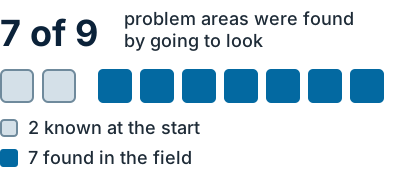
On TransNet, two of the nine problem areas were known at the start. The other seven surfaced during field discovery.
The project’s starting assumptions, mine included, changed the same way.
| What the project assumed at the start | What going to look found |
|---|---|
| Labeling problems had to be fixed in the operating room. | Label problems seen in the OR often started upstream. |
| Adopting a label standard would resolve the issues. | A label standard alone would not have fixed most of the safety issues. |
| Labeling and tracking organs should not be that difficult. | The organ recovery process is extremely complex. |
From my 2014 write-up on the TransNet site visits, lightly edited.
The five moves
1. See the work
Watch and time the process where it happens, and map every handoff and check.
- TransNet: Field observation came first. Over the project, I observed 69+ organ recoveries and visited 14 organ procurement organizations and about 19 transplant centers.
- Today: My coaching platform’s specs came from how the practice works day to day, starting with client calls.
2. Borrow what works elsewhere
Ask which industry already solved a problem shaped like this one.
- TransNet: Package-delivery labeling, where the label is printed from system data and scanned at handoffs instead of written by hand.
- Today: Software product management, applied to AI coding agents: written specs, a ranked roadmap, and a release I approve.
3. Remove the steps that cause errors
Every handwritten entry, retyped field and repeated check is a chance for error and a cost in time. Remove the step if you can. Simplify it if you can’t.
- TransNet: Visual and audible verification checks in the labeling workflow fell from 62 to 7. The data was checked once, at entry, so the repeated checks downstream were no longer needed.
- Today: One platform replaced the Power BI dashboards and data pipelines I had built earlier.
4. Get it adopted
People adopt what fits their work and what they have practiced. Design for that from the start, and keep the barrier to entry low.
- TransNet: A tablet and a portable printer, and a timed training simulation I designed, in workshops a UNOS lead and I led. Use was voluntary at first. The OPTN Operations and Safety Committee set 80% voluntary adoption as the threshold before use became required. Once it was reached, a date was set, and use was required from June 2017. By then, every US organ procurement organization was using it.
- Today: Each AI feature fits the practice’s existing workflow, with a human check. The coach releases call briefs, and staff verify supplement-label readings.
5. Hand it off
A change lasts when its long-term owner runs it.
- TransNet: Development, training and support moved to UNOS.
- Today: A Field Review ends with a baseline and a ranked change list that the client’s own team can act on.
TransNet succeeded because of HHS sponsorship, HRSA funding, UNOS as a day-to-day partner in development, training and field access, and the OPOs and transplant centers that opened their operations.
Where AI fits
- Remove the step before you automate it. If a step adds nothing, AI only makes a useless step faster.
- A person checks every AI output that matters. On my platform, the coach releases each call brief, and staff verify supplement-label readings.
- Measure against a baseline. Time the work before the change, so you can tell whether AI helped.
Want this on one of your processes? See Work with me.